Related Posts
-
 05 Mar 2025 | THK G20 Bali GBFA Dialogue with Danantara Indonesia (Online)
-
 20 Jan 2020 | Tri Hita Karana United in Diversity Presidential Council for Better Business Better World “Realising Indonesia’s Potential Through Sustainable Development” Private Dinner Dialogue, Davos
-
 15 Oct 2020 | Tri Hita Karana Roadmap on Blended Finance Virtual Meeting
-
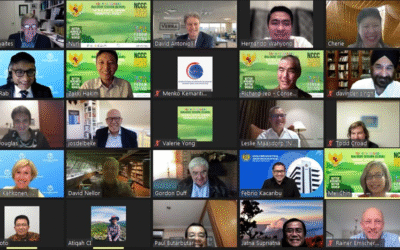 01 June 2021 | Tri Hita Karana Dialogue Session (Cloud): “Natural Capital, Carbon, Communities Market”
Background and Rationale
Artificial Intelligence is reshaping economies, societies and governance. Yet, its transformative power depends not only on vast computing resources — data centres, high-performance clusters, and the clean energy and water that sustain them — but also on how AI itself is developed, owned, and governed. Today, access to this “sovereign compute” and the capacity to develop “sovereign AI” — AI systems and capabilities that reflect a nation’s own priorities, values, and data — has become a strategic imperative.
The global race to build AI-ready infrastructure and capabilities is accelerating, yet investment flows are fragmented and capacity remains heavily concentrated in a few geographies, while many emerging economies risk being left behind. This imbalance threatens to widen the digital divide and limit innovation in critical fields like health, life sciences, agriculture, and climate adaptation – areas where AI can deliver life-changing benefits. At the same time, the highly energy- and water-intensive nature of datacentres and compute clusters risk deepening the climate footprint of the digital economy. Building distributed, trusted, and sustainable compute capacity together with inclusive, ethical, and AI capabilities across emerging and developed economies alike is now a global public good.
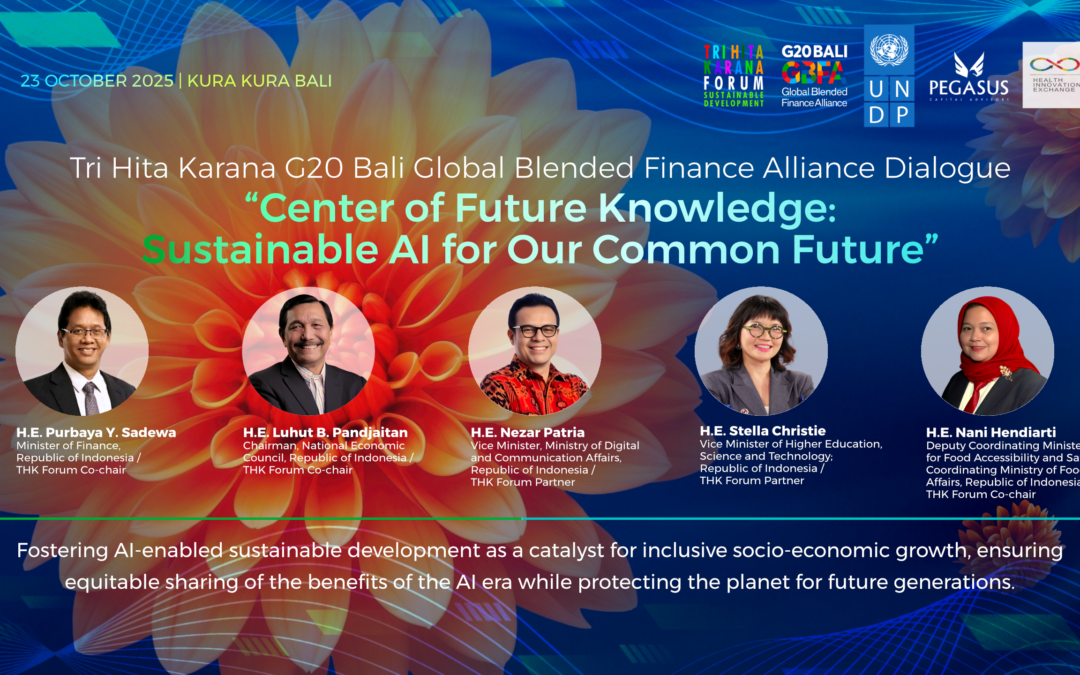
The Tri Hita Karana G20 Bali Global Blended Finance Alliance Dialogue — “Center of Future Knowledge: Sustainable AI for Our Common Future” will convene leaders, policy-makers, development agencies, Big Techs, institutional investors, innovators, academia and NGOs to address the challenges and opportunities presented by AI as a lead-up to COP30 and the 2026 World Economic Forum Annual Meeting in Davos.
Jointly hosted by the Tri Hita Karana Forum and the G20 Bali Global Blended Finance Alliance, with knowledge partner United Nations Development Programme (UNDP), in partnership with Pegasus Capital Advisors, the event provides a neutral platform to align public and private capital, policy frameworks, and innovation ecosystems. Its shared goal: to foster AI-Enabled Sustainable Development as a catalyst for inclusive socio-economic growth, ensuring that the benefits of the AI era are equitably shared while protecting the planet for future generations.
The dialogue will focus on the following key priority areas:
- Capital Flow for Sustainable Compute with Clean Energy: Bali 2045
- Health and Climate Resilience Commons
- Tri Hita Karana AI Entrepreneurs and the Future of Talent & Job
Objective
- Catalyze international collaboration to accelerate the build-out of compute infrastructure across the Global South and beyond.
- Align capital flows from blended finance institutions, sovereign wealth funds, development banks, and Big Tech toward scalable, bankable compute and sustainable energy projects.
- Strengthen innovation ecosystems by connecting AI entrepreneurs, researchers, and public agencies to the compute, local data, talent, and regulatory frameworks needed to build trustworthy sovereign AI systems to compete globally.
- Showcase regional opportunities in Southeast Asia and other EMDEs as part of a more resilient, diversified, and sustainable global AI and compute infrastructure network.
Several announcements and commitments were made at the end of the Dialogue included:
1. Joint LoI Signing for the Bali Climate and Health Resilience AI Hub led by Health Innovation Exchange (HIEx) with a coalition of pioneering partners: Swasti Health Catalyst, Bayer Foundation, Partisia, and UNICEF.
2. Alliance for Sustainable Inclusive Intelligence (ASIGN) – A strategic platform to support the Global Compute Blended Finance Roadmap
3. Joint Statement of Support: Towards Indonesia Emas 100% Renewable Energy & Bali Net Zero Emissions 2045
Summary Report
Download Report